
Every chancing tool I used in high school ended the same way. Fifteen minutes of entering everything about myself, and then one number. I either get into the school or I do not, so what was that number supposed to do for me? It did not tell me what stood out in my profile. It did not tell me what to fix. It was a number to stare at and feel good or bad about, and nothing else.
So when we built Committee Review at Trajecta, we built the opposite thing. A specialist reads your essays and files a report. Four AI admissions officers then read your entire application through different lenses, argue about it in writing, and a chair settles the argument into a decision with next steps. This post is the honest build log. What it turned out to be good at, the genuinely dumb stuff it did along the way, and the things no tool can see, ours included.
Where the idea came from
The idea did not start in admissions. I ran into a startup that simulated a founding team. You are a solo founder, and AI plays your cofounders, each with a different role, each acting like an actual person in the room. That stuck with me, because admissions committees have almost the same shape. Nobody outside knows any school’s exact rubric anymore, but the process itself is public knowledge. One or two officers read everything, then a committee weighs those reads and gives the final verdict. The structure was easy to map. The question was whether the argument inside it would be worth reading.
The other push was personal. Chancing tools were useless for my profile specifically. I had a narrow, deep spike in a small corner of music, and no formula knows how to weigh a national composition award against a GPA. They just saw the GPA. The human version is worse. A stranger in a comment section telling a seventeen year old they are cooked is not advice. It feeds whatever the kid already believed and calls it honesty. A committee that actually reads the whole file was the only version of this that could work for someone like me.
The first file it read seriously was mine
The run we published is my real Northwestern ED application. Music composition, a 3.81 unweighted GPA, three national composition awards. The room split three to one. The academic reader called my GPA a hard ceiling and held at toss-up. The other three argued the portfolio carried it. The chair sided with the three, which is also what Northwestern did in real life.
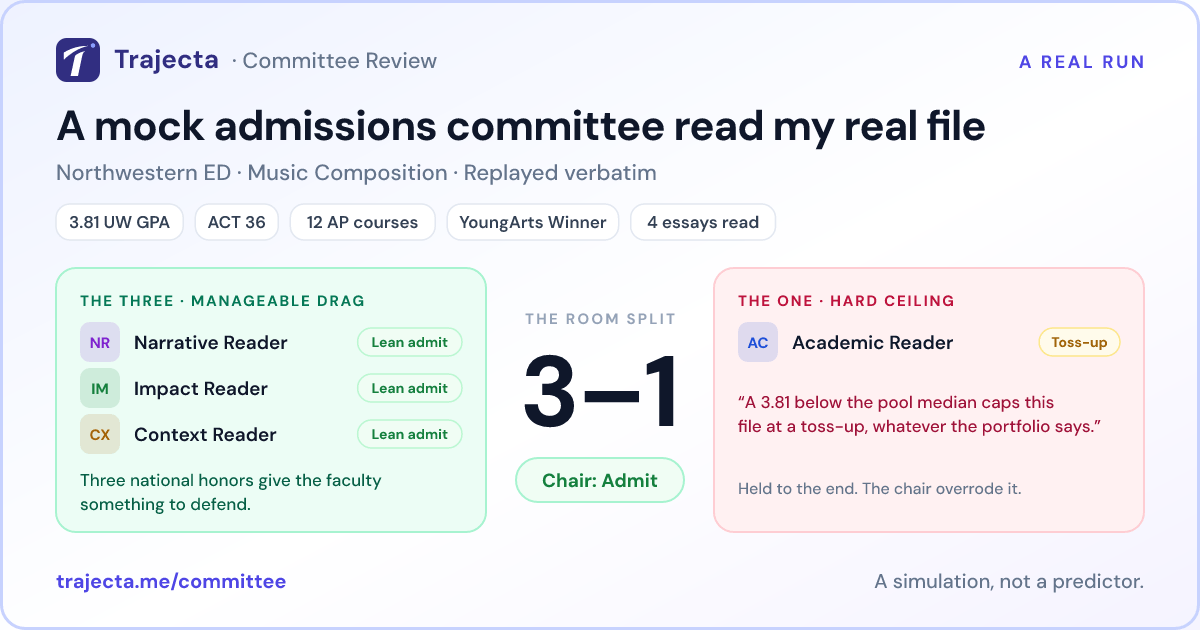
A 3.81 below the pool median caps this file at a toss-up, whatever the portfolio says.
Here is the thing about the dissent. I agree with it. The 3.81 was my biggest fear going into college apps. I had six Bs on my transcript and I was sure my GPA was cooked for top schools. I was equally sure my music spike was national level. I had no idea how those two things mixed, because there was nobody like me to compare against. So when one reader out of four looked at my file and said the GPA caps this, that was not the AI being harsh. That was the exact conversation I was afraid real committees were having about me.
I also ran the what-ifs on myself. Same file, pointed at Stanford as a CS major instead. Lean denies. And they were right. My profile is a music creative who happens to code. Aimed at CS, the story stops making sense. Then I reran the schools I actually applied to, with the majors I actually picked, and the results came back matching what really happened, waitlists included, along with the admit that shocked me in real life. One applicant reproducing his own outcomes proves nothing statistically, and this whole post is me telling you not to trust tools that promise prediction. But I would be lying if I said it did not matter to me.
It spots padding from a mile away
A format exercise with no genuine connection.
The chair gave me four pieces of advice, and two of them stung. One was my community supplement. My college consultant suggested the concept junior year and I thought it was a cool idea. The committee called it a format exercise with no genuine connection to my narrative. Reading that was mostly confirmation. I had carried the same quiet doubt about that essay the whole time and never acted on it. It might not even be the idea’s fault. I never connected it to myself, and the reader said so out loud.
The other sting I actually push back on. The impact reader discounted my geography bee’s reach number as inflated. We really did write four hundred questions and host a district bee across four middle schools. The number was real. I left the criticism in the published run anyway, because the suspicion behind it is the feature. This thing is deliberately skeptical of big round numbers, and sometimes that skepticism hits something true.
I tested that skepticism properly. I injected four fake activities into my own profile, common-sounding stuff I thought would pass without a second look. The readers flagged all four, and the verdict on that run dropped from waitlist to reject. Honestly it might be too good at spotting bullshit, since it occasionally side-eyes real activities, like my geo bee. But if the choice is a tool you can pad or a tool you have to convince, I know which one actually helps a student.
This matters because of a boring constraint. The application gives you about 150 characters to describe each activity. Students with genuinely great activities lose real ground because the description reads generic, after years of actual work. No percentage will ever tell you that your best activity is underwritten. A reader that reacts to your wording the way an admissions officer would is, I think, the most quietly useful thing in the product. In my experience even consultants rarely do this well. They polish your list. They do not show you how it lands.
The genuinely dumb stuff along the way
A build log that skips the failures is just an ad, so here are mine.
The UC Riverside incident
When I first added program-level selectivity, the readers became obsessed with major fit. I ran my file at UC Riverside as a CS applicant, a school that admitted me in real life as a safety. One toss-up and three lean denies. It was telling me my activities were not good enough. For UC Riverside.
The Purdue crisis
My cofounder ran his own high school profile through an early build and got rejected from every single school, including the one he attends. The write-ups were so convincing he briefly questioned whether he deserved to be at Purdue. He goes to Purdue. He earned Purdue.
The 4.0 that was not good enough
While wiring up school-specific GPA data, I ran a what-if with a perfect 4.0 unweighted at Stanford. The academic reader told me my GPA was on the low end for accepted students. A 4.0. The maximum. Alright buddy.
The common thread is that a language model will happily be confident and wrong, and it is disturbingly good at writing persuasive explanations for bad conclusions. The committee behaves today because of everything wrapped around it. Reference data it has to read against, restricted lenses for each officer, and a chair whose job is to weigh arguments instead of averaging vibes. The eloquence is native. The discipline had to be engineered.
Why it runs conservative on purpose
The committee is tuned a notch conservative, especially at reach schools, and the reasoning is not noble. A false admit hurts more than a false deny. If the room tells you a reach looks likely and the school says no, that failure follows you into April. If the room is too cautious and you get in anyway, you get a great surprise. And no matter how many times we say simulation, some people will treat any verdict as a prediction. So the verdicts lean toward the outcome that does the least damage when wrong.
Hooks made this an easy call. Recruited athletes, legacy, the handful of statuses that really move decisions, are exactly where outside tools are most blind. A real hook is not a checkbox. It changes the entire conversation around a file in ways that never show up in public data, and hooked applicants really do land schools that look out of range on paper. The committee knows the direction a hook pushes. It refuses to guess the size.
What it cannot see
Being honest about limits is easier when the limits are structural. A partial list of what Committee Review will never read:
- Recommendation letters. They are sealed, you cannot upload what you never see, and some schools weigh them as one of their biggest factors. It is what it is.
- Portfolios and auditions. This one is personal, because I am a music applicant and my portfolio probably carried my own admit. Real portfolio review is two or three professors in that exact department applying standards that exist in no public dataset. Simulating that would be praying the model guesses right, so we do not.
- Interviews. We are not going to pretend a chatbot rehearsal tells you how your alumni interview will go.
- The reader’s mood. Real officers are human. The read before lunch and the read after lunch are not the same read. That variability is part of the real process, and no simulation should claim to model it.
Then there is the school-side fog. Most schools do not publish program-level admit rates, so a friendly headline rate can hide a brutal one for the program you actually want, and inferring from the program’s reputation is the best anyone can do. Yield protection is real at some schools and unknowable from outside. When I applied, I was convinced one of my UCs was waitlisting students above a certain GPA band because they knew those kids would not come. Maybe. I cannot prove it, nobody outside the building can, and I do not like publishing speculation. And institutional needs are fully invisible. Nobody knows what a university president wants changed about next year’s class.
Here is the honest counterweight. GPA, test scores, coursework, activities, awards, essays, context. That is most of your application, and all of it is visible. If you believe the invisible parts are the main thing deciding your outcomes, you are probably coping.
No secret rubric
Everything the committee reads against comes from the school’s own published numbers. The Common Data Set filings, the admit rates, the enrolled GPA bands, and the factors each school itself says it weighs. The reason is that admissions folklore is an industry. College consulting has spent decades selling the idea that every school has a hidden want, and that with the right insider you can reshape your whole profile into it. The truth is duller. We mostly do not know any school’s actual rubric. We know the CDS, the structure of the process, and what schools say on their own websites. Everything past that is somebody’s personal experience dressed up as a rule. Including mine. Every person who tells you what a school wants, me included, is one opinion out of millions.
I will say the part that matters more than the product. I grew more in high school from doing the activities I actually loved than I ever would have from tailoring my life to a rumor. There were people online happy to tell me my life was ruined by six Bs and that Northwestern does not take people like me. Northwestern took me. Anchor on what schools publish, spend your energy on the file you can control, and log off the threads.
Who this is not for
If you want a verdict to screenshot, this is the wrong tool, and honestly no tool deserves that job. The value of the committee is the argument. The four reads, where they disagreed, and the specific list of what to change. The verdict is the least interesting part of the output, and it is tuned conservative anyway.
It is also not for families who see admissions as a pure academic ranking. I grew up around parents who treated the process like a single-exam system where grades are everything. This tool would not help them. They would fixate on the verdict, add pressure on their kid, and skip everything the room actually said. If that is the frame, the first step is not a simulation. It is understanding how holistic review works at all.
Judge it yourself
A 3–1 room. The composition spike carried a below-median GPA.
The run this post keeps referencing is public, end to end. All four reads on my real application, the three-to-one split, the written disagreement, and the decision. I put my own file up because asking students to trust a black box with their applications, without showing them a full run first, is exactly the kind of thing this industry does that I do not want to do.